
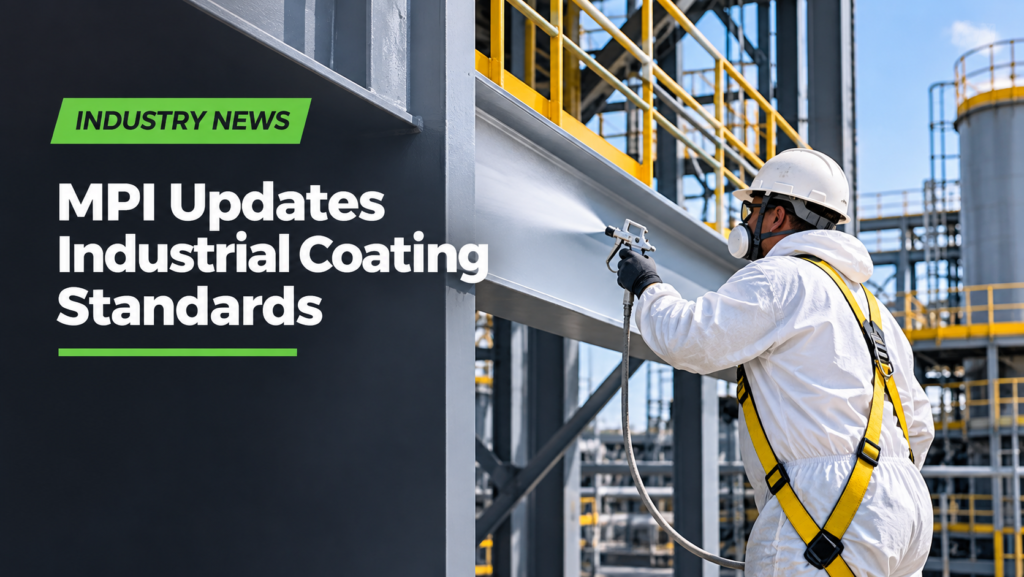
The Master Painters Institute (MPI) has relaunched five categories within its 500 Series of Industrial Standards, with approved products now available for specification across industrial infrastructure applications.
The development highlights the importance of established industry standards in selecting protective coating systems for industrial environments, where durability, corrosion resistance, and long-term performance are essential.
Why Industrial Coating Standards Matter
Industrial painting involves much more than applying a protective finish. Coating systems must be selected according to the substrate, environmental exposure, operating conditions, and performance requirements of each facility.
In industrial environments, surfaces may be exposed to moisture, chemicals, temperature fluctuations, abrasion, and other conditions that accelerate deterioration. Selecting an incompatible coating system or overlooking surface preparation can result in premature coating failure, corrosion, and expensive maintenance.
Industry standards help establish consistent performance expectations and provide specifiers, facility owners, and contractors with a clearer framework for evaluating coating products.
The Importance of Choosing the Right Coating System
A successful industrial coating application begins long before the paint is applied.
The selection process should account for:
- Substrate conditions: Different materials require compatible coating systems and preparation methods.
- Environmental exposure: Moisture, chemicals, temperature, and atmospheric conditions influence coating performance.
- Surface preparation: Proper cleaning, removal of corrosion, and surface profiling are essential for coating adhesion.
- Product compatibility: Primers, intermediate coats, and topcoats must work together as a complete system.
- Long-term maintenance: Coating selection should consider the expected service life and maintenance requirements of the asset.
These considerations are particularly important in industrial facilities, manufacturing environments, and infrastructure projects where coating performance directly affects asset protection and maintenance costs.
Staying Current with Industry Specifications
Alongside its industrial standards update, MPI has also relaunched its online Architectural Painting Specification Manual (ASM) and Repainting Specification Manual (RSM), featuring an updated design and improved user experience.
The manuals provide guidance on coating system selection, surface preparation, product evaluation, and specification development for new construction and repainting projects.
For painting contractors, project owners, and specifiers, staying informed about evolving industry standards and technical guidance is an important part of delivering consistent, high-quality results.
A Performance-First Approach to Industrial Painting
At HiTech Painting, understanding the requirements of each project is essential to delivering durable, reliable coating solutions.
Industrial painting specifications should never be treated as an afterthought. The right coating system, combined with appropriate surface preparation and professional application, helps protect industrial assets, extend service life, and reduce the likelihood of premature deterioration.
As industry standards continue to evolve, keeping up with developments from organizations such as the Master Painters Institute helps reinforce the importance of quality, technical knowledge, and performance-driven painting practices.
Learn more: Visit the Master Painters Institute to explore its industrial coating standards and technical resources.